That Local Girl: Building a Community Through Business and Heart
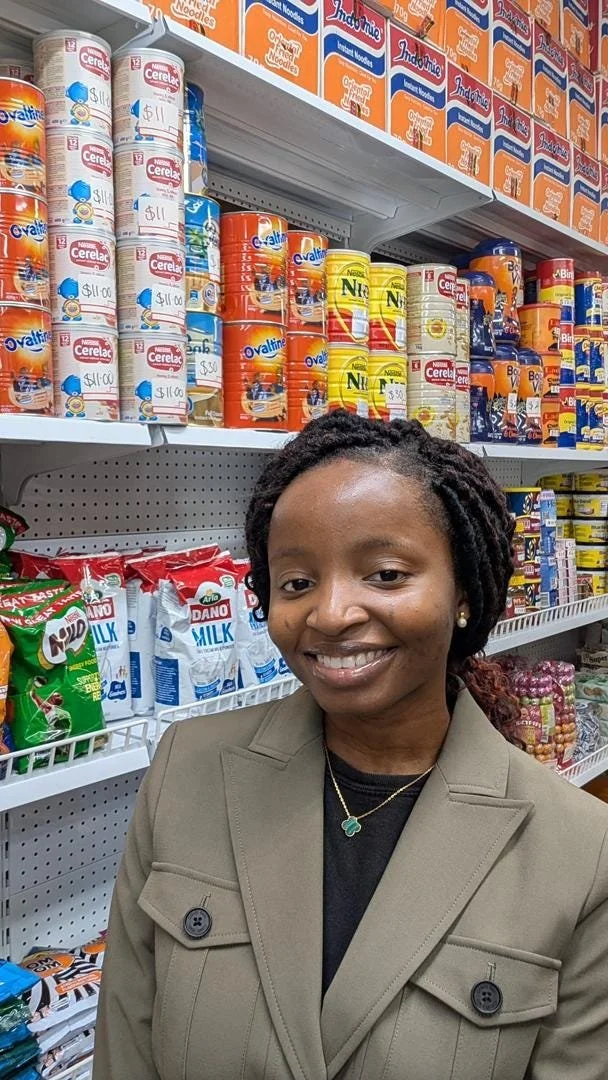
Rofiat Olusanya || Credits: Proof Strategies
She turns the key, and opens the shop.
Deliveries arrive in stacks while customers walk through the door. She lines her shelves with agege bread, chikwangue, rows of spices, and lines of books; pieces of home, pieces of history.
For Rofiat Olusanya, she is that local girl centring community and representation at the heart of everything she does.
With her very own African grocery store, That Local Girl, she not only filled a gap for centralized Pan-African goods in Toronto, but she also answered a call to connect Canada and Africa, uniting people with their childhoods, their ancestry, and with each other through stories and food.
“I wanted a place where everybody feels welcome, especially as an African. I don’t want it to be like, “oh, this is Nigerian,” or “this is Ethiopian,” or whatever. So I opened a space where every African, regardless of their country, their culture, their tribe, can just walk in and know they are going to be represented,” Rofiat said.
Originally from Nigeria, Rofiat never thought she would go into the African grocery business, but after turning 25, she had the opportunity to purchase an existing African grocer while working in tech as a full-stack developer.
“Starting was a big deal because I was really doubting it,” Rofiat shared. “I didn’t expect this much work as a business owner. Initially, I was working my nine-to-five, and I had hired someone in the store to just work until I got back from work. But even though someone was working, I was still overwhelmed with the amount of work that was waiting for me by time I came back.”
Now she focuses on the store full-time and uses her tech background as a catalyst for different parts of her business, especially online. She enjoys meeting people from different countries and learning and sharing food.
That is something she shares with her 11.3k-follower community on TikTok. Along with her entrepreneurial journey, she features recipes, exemplary African visionaries, and the history and legacy behind the food she stocks, which has led to her being featured in TikTok’s Black History Month celebration.
“There is a lot of African stores, but unfortunately, we do not allow ourselves to learn about each other’s culture, each other’s country, or each other’s food. So I’m hoping that if, let’s say, a white person walks into the store and they want to learn about [or] they want to try pepper soup for the first time, maybe there’s a way that they can learn how to make it without making it too spicy. Maybe there’s a way where Kenyans make it that they don’t make it spicy, but it is still soup, and you can actually make it like that,” she said. “I’m hoping that when somebody needs an ingredient, and even if they’re not African, maybe they’re Italian, Caribbean, they can walk into the store and say, okay, this thing is called something else, but in my country, this is what it’s called, and I know I can find it inside of this store, regardless of what my culture is or what my country is.”
Her intention for inclusivity and cultural celebration is ingrained into every level of her store. She ensures all of her clients find the ingredients they want at top quality.
“I always tell the people who want to give me the food they’re creating, I don’t mind if you want to sell it to me, but if you’re going to put it on my shelf, you need to show me that it actually went through the process it was meant to go through, because I’m not just going to take something from you because you’re my sister,” she said. “When it comes to most Africans, or most of the people who are my customers, their biggest problem has been that they can’t trust African vendors, because, well, maybe the food is expired, the food is not good, the food is not this, it’s not that, for whatever reason. I’m trying to prevent that from being the story that is attached to That Local Girl.”
And Rofiat shared this with her community. They have been there with her as she reflected on a robbery she experienced, her thoughts on Toronto traffic, and they are active conversationalists about what makes it onto the shelves, transparent pricing, and the store’s buying power.
“I think in life in general, it’s just important for people to know where you stand when it comes to this business,” Rofiat explained. “I’m hoping that the next generation will be more comfortable taking this business on, and also building bigger and better than our generation have done. Right now, a lot of people think that if you’re educated, you shouldn’t go into African store, or if you have any background knowledge, why would you leave tech to go into African store? That’s like the question I get every day: Why would you leave a stable job to go to African store? But I think if people can see, okay, business can be rough, business can be crazy, but it is beneficial.”
Rofiat wishes she had shown the ups and downs of her journey from the very beginning. When she started, she was chasing perfection and hoping to be at the level of large stores.
“I was trying to be at a bigger store level right on the first year, but that also meant a lot of things were going wrong, and I was trying to keep face and just hide the face,” she said.
When it came to the robbery, Rofiat did not share it with her community at the time. It “broke [her] heart,” and “impacted” her relationship with people.
“So it really did impact my trust towards people with allowing people into my store,” she shared. “But I’m learning to give people the space to actually support me again, because at the end of the day, I do need people. I can’t do this business on my own, especially when the things are falling apart. I can’t, I can’t do it on my own.”
Now she would tell herself that she has the strength to handle whatever may come, and that everything is “figure-out-able.” And by having the courage to post online, people are willing and able to support.
“When there’s a space where we can learn through food, stories and other people who are part of the culture, they will be able to embrace each other a little bit more, just a little bit more.”
Along with the store, Rofiat is achieving her fitness goals and taking marketing classes. On how she balances it all, she said, “Everything is not important every day,” and some days it’s okay to do absolutely nothing.
“Some weeks is really slow, and some days are really slow, actually. So I prioritized learning on those days. And if it’s driving, I allow myself to just drive around, deliver, pick up, and just allow myself to not feel guilty for not doing the school work or not doing the business work. I allow myself to be present in what exactly I’m doing, instead of feeling guilty of not completing a part of it,” she said.